If you are comfortable fitting internal doors, hanging kitchen units or doing similar practical work, measuring for a glass partition is straightforward. Take the finished opening sizes in millimetres, use the smallest measurement and leave the manufacturing allowances to us.
Toughened glass is made to the final sizes and cannot be cut or drilled afterwards, so a careful check before ordering matters.
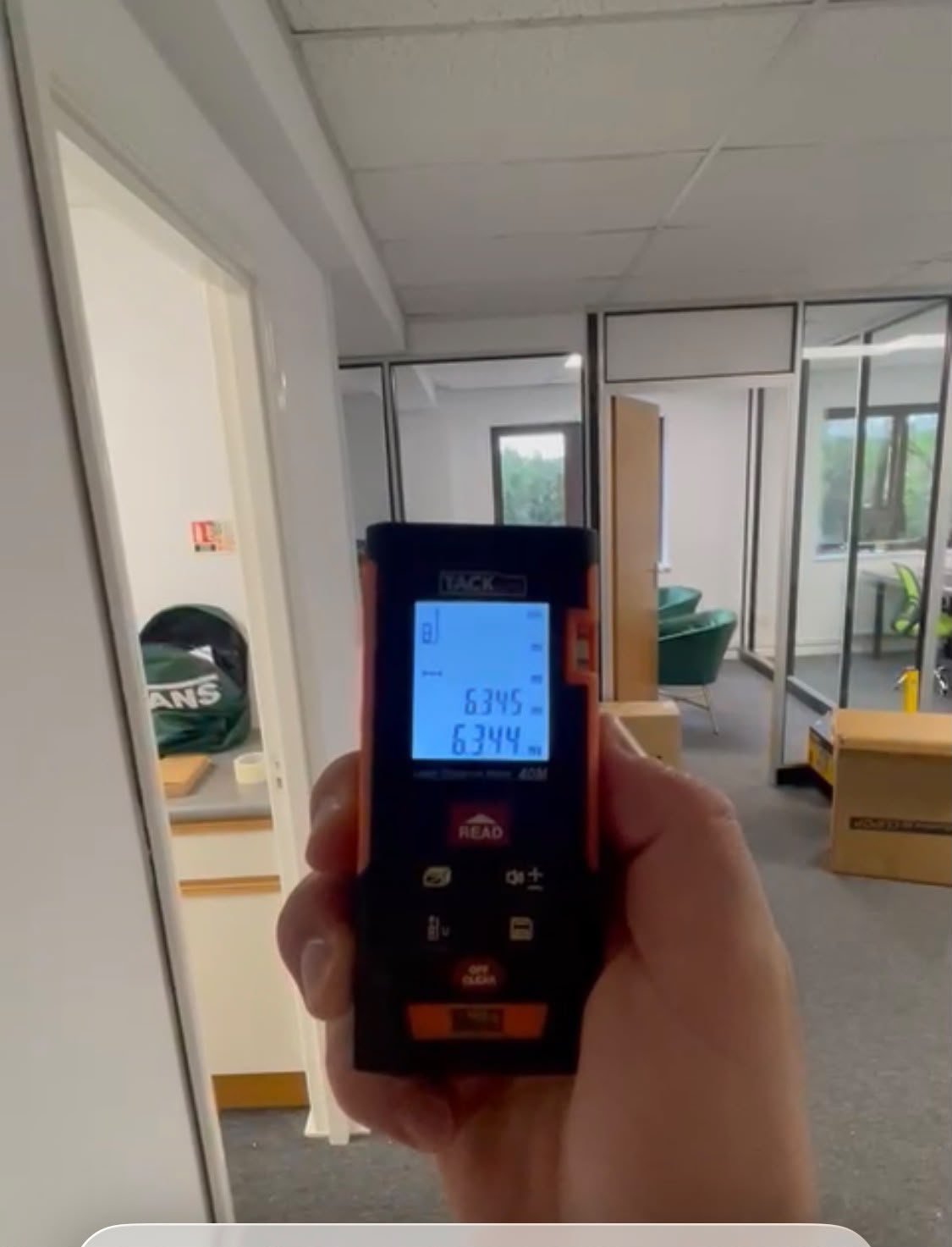
Checking the opening with a laser measure.
Measure in three placesWidth at top, middle and bottom; height at left, centre and right.
Use the smallest sizeThis is the tightest point that the completed partition must fit.
Do not make deductionsGive us the tight opening size and we calculate the glass and fitting tolerances.
1
Measure the width of the opening
Measure wall to wall at three heights: top, middle and bottom. Use a laser measure or steel tape, record all three measurements in millimetres and submit the smallest.
Measure wall to wall, not skirting to skirting. The wall channels need to sit flush against the wall, so the skirting is cut where the channels meet it. If trunking runs along the wall, timber can be fitted flush with the face of it and the width measured from timber to timber.
2
Measure the height of the opening
Measure from finished floor to finished ceiling at the left, centre and right of the opening, then submit the smallest height.
If the partition includes a door, measure particularly carefully at the exact position where the door pivot will sit. Door heights have very little tolerance.
3
Record skirting, trunking and obstructions
Skirting can be cut so the channels mount against the wall, or timber can be used to pack the wall out to the face of the skirting. The same timber-packing method works where trunking crosses the partition line.
Tell us about ceiling-level lights, air ducts, ceiling roses or anything close to the door swing. A transom door with a panel above the door leaf can often allow the door to swing beneath an obstruction.
4
Allow for the finished floor
Complete the flooring before measuring. Measure from the finished floor, including carpet, to the finished ceiling.
Door clearances: frameless doors have 13mm beneath them, allowing up to 10mm carpet to be fitted around the door afterwards. Framed doors have 5mm clearance, so please contact us if flooring will be laid later.
5
Submit the tight sizes
Send the opening dimensions exactly as measured. Do not deduct anything for channels, gaskets, doors or fitting tolerances.
We calculate the manufacturing allowances, generally including 15mm next to the walls, 5mm either side of a frameless door and 4mm for dry joins between panels, together with the correct allowances for hinges and framed doors.
6
Complete the final check
Before you order, check that every measurement is in millimetres and that you have used the smallest width and height without making deductions.
Finished wall-to-wall width
Finished floor-to-ceiling height
Door-pivot height checked
Flooring situation confirmed
Obstructions noted
Nothing deducted
Uneven walls, floors or sloping ceilings
Uneven openings are common and do not automatically prevent a glass partition from being fitted. The right solution depends on the amount and position of the variation.
Variation under about 10mmSubmit the smallest measurement. The channels can normally be packed during installation.
Larger variationEmail us a sketch showing the width at top, middle and bottom and the height at left, centre and right. We will advise on the correct configuration.
Significantly sloping floorA 50mm floor channel can accommodate 20mm more slope than the standard 30mm channel. The glass is manufactured square and must be levelled on packers inside the channel. Call before ordering so we can specify it correctly.
Significantly sloping ceilingThe ceiling channel can be fitted level at the smallest height, or panels can be made at different heights to follow the ceiling line. The door height is especially important.
Common measuring questions
Before you place the order
How do I measure for a glass partition?
Measure the width wall to wall at the top, middle and bottom. Measure the height floor to ceiling at the left, centre and right. Use the smallest width and height and submit the tight opening dimensions in millimetres.
Should I measure wall to wall or skirting to skirting?
Always measure wall to wall. The wall channels need to sit against the wall, so skirting is cut where the channels meet it or the wall is packed out with timber to the face of the skirting.
Do I deduct anything for channels and gaskets?
No. Submit the opening dimensions exactly as measured. We allow for the channels, gaskets, doors, joins and fitting tolerances when calculating the manufactured parts.
What if my walls or ceiling are uneven?
Use the smallest measurements. Variation under about 10mm can normally be packed behind the channels. For larger variation, send us a sketch with measurements at several points and we will advise on the correct configuration.
Do I need to allow for carpet under the partition?
Complete the final flooring before measuring and measure from the finished floor, including carpet. Frameless doors have 13mm clearance underneath and framed doors have 5mm; contact us before ordering if the flooring will be laid later.
Ready to configure your partition?
Give the calculator the tight opening size
Once your measurements are checked, enter the finished opening width and height. The calculator works out the panel sizes, materials and accurate price. If anything is unusual, call 0800 772 3992 or email sales@nationalglasspartitions.co.uk before ordering.